
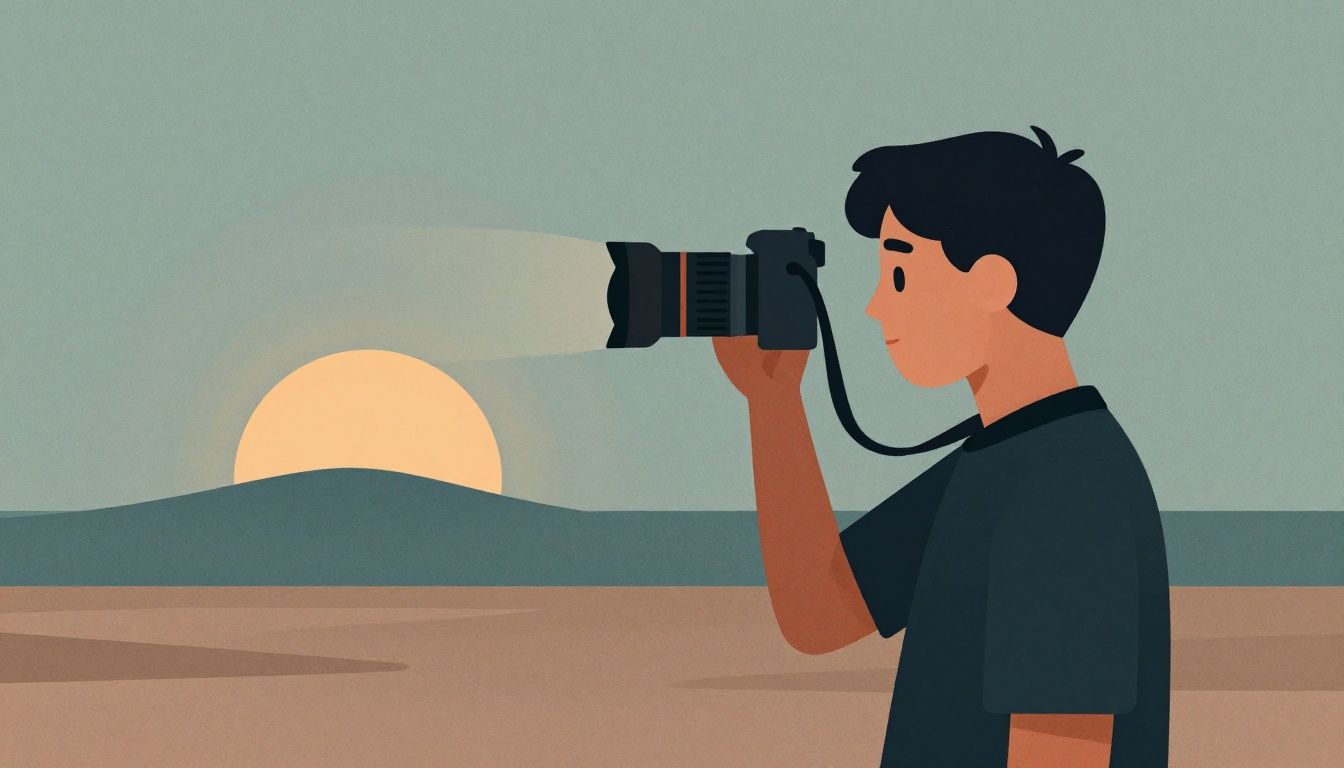
You've framed the perfect golden-hour portrait, your subject backlit by a setting sun over the Gulf. But when you review the image, a rainbow-colored orb or a hazy veil of light ruins the shot. That's lens flare—light scattering inside your lens—and it's the bane of beach photographers who love dramatic backlight. The good news: you can control it with a few field-tested techniques.
Which technique is most effective when shooting directly into the sun?
Select one answer.
Why Lens Flare Happens
Lens flare occurs when direct sunlight hits the front element of your lens and scatters internally before reaching the sensor. This creates two types of artifacts: specular flare (those circular blobs or streaks) and veiling flare (a subtle loss of contrast and sharpness in shadow areas). Wide-angle lenses are more prone to flare because their broader field of view lets in more stray light. Understanding this helps you choose the right fix.
Technique 1: Use a Lens Hood—But Know Its Limits
A lens hood is your first line of defense. It shades the front element and blocks stray light from entering at an angle, which reduces both specular and veiling flare. However, a hood won't help when you're aiming directly at the sun—the light comes straight in, bypassing the hood's protection. As one photographer noted, "A hood will not make a difference because your camera's angle into the sun is very direct." So use a hood for angled light, but don't rely on it for direct sun shots.
Technique 2: Block the Sun with Your Hand or a Hat
When the hood isn't enough, physically shade the lens. Hold your hand or a hat just outside the frame to block the sun's direct rays, then remove it before pressing the shutter. This trick works even with wide-angle lenses if you position your hand carefully. Shading the lens also improves color and contrast, as demonstrated in side-by-side comparisons where hand-shaded shots showed richer tones than those with only a hood.
Technique 3: Shoot at a High f-Number
Stopping down your aperture—using a high f-number like f/16 or f/22—reduces the amount of light entering the lens and can minimize flare artifacts. This also creates a pleasing sunstar effect, turning the sun into a sharp, starburst shape. Combine this with a tripod to maintain sharpness at small apertures.
Technique 4: Reposition or Wait for the Light
Sometimes the simplest fix is to change your angle. Move so the sun is partially hidden behind your subject, a dune, or a cloud. This not only reduces flare but also gives you a more balanced exposure. If you can't reposition, wait for the sun to drop lower or for clouds to diffuse it. As one guide suggests, "put the sun on the edge of your photo, just outside the photo, behind something" to get beautiful backlight without the flare.
Technique 5: Shoot Two Frames and Blend in Post
For scenes where you can't avoid direct sun, use the exposure-blending technique: take one shot with the sun blocked (using your hand or lens cap) to get a clean frame, then another with the sun included. In Photoshop, layer them and mask out the flare. This is a common pro landscape technique and works well for beach scenes where the sun is a key element.
Quick Checklist for Flare-Free Backlit Beach Shots
- Attach a lens hood for angled light.
- Use your hand or hat to shade the lens for direct sun.
- Set a high f-number (f/16 or higher) to reduce flare and create a sunstar.
- Reposition so the sun is partially hidden by your subject or an object.
- Shoot two frames (one blocked, one not) and blend in post.
- Check your LCD or histogram for hidden flare—it's often invisible in bright sunlight.
How the Featured Expert Can Help
If you're shooting in Panama City Beach and want professional results without the guesswork, Coastal Heirloom Studio offers luxury beach portraits for families, couples, and events. Their experienced team, led by Michael and Kristy Evans, handles the tricky coastal light for you, delivering heirloom-quality images with personalized sessions and professional editing.
Test Your Knowledge
Which technique is most effective when shooting directly into the sun?
- A. Using a lens hood alone
- B. Shading the lens with your hand or hat
- C. Increasing ISO to 3200
Correct answer: B. A lens hood doesn't help when the sun is directly in front of the lens; hand-shading is a proven method to block stray light.