
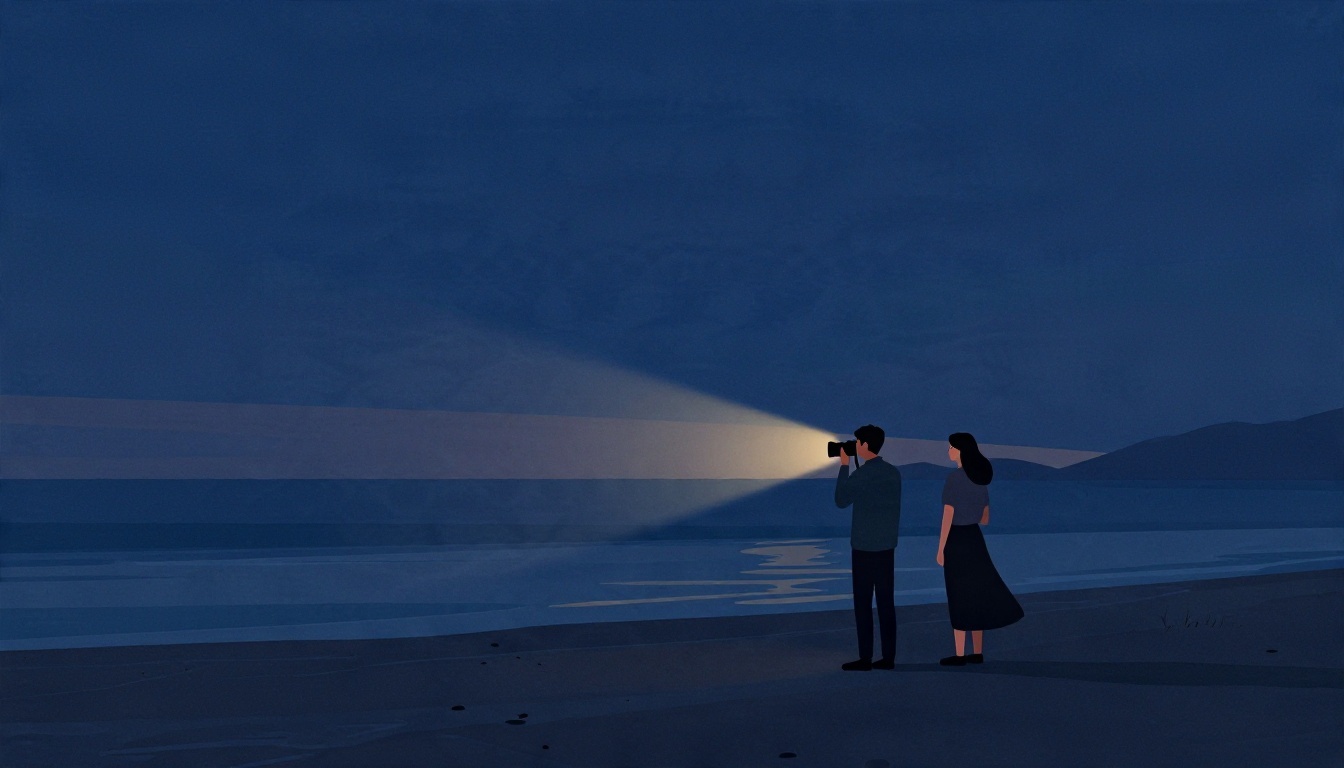
Blue hour is the window just after sunset (or just before sunrise) when the sky turns a deep, even blue. It is beautiful for beach portraits, but it is also unforgiving: the light fades fast, and if you have not planned your settings and your flash, you will spend the best minutes fumbling. This guide walks you through timing, exposure, lighting, and composition so you come home with usable frames instead of a handful of dark, noisy ones.
Roughly how long does blue hour last?
Select one answer.
Know how long you actually have
Blue hour is short. According to OM SYSTEM's guide to shooting blue hour, it lasts from 20 to 40 minutes, sometimes less. That is your entire working window, so treat it like a shot list, not an open-ended session.
- Check the exact sunset time for your beach before you leave.
- Arrive early and scout your composition while there is still warm light.
- Note which direction the sun sets, because that side of the sky stays brightest longest.
- Plan to shoot toward where the sun has set, with open space in front of you, as Jen Bilodeau's blue hour portrait tips recommend.
Set your exposure before the light drops
Work in manual mode so the camera does not chase the changing light. A practical starting point:
- Set a low ISO (roughly 100–400) to keep noise down, as Digital Photo Mentor suggests.
- Choose an aperture that gives you the depth of field you want for the scene.
- Set your shutter speed for the ambient sky, then adjust as the light falls.
- Expose for the midtones rather than the brightest or darkest part of the frame.
- Shoot in RAW so you can recover color and shadow detail later.
If you are handholding, establish a usable shutter speed first, then adjust aperture or ISO around it. On a tripod, you can simply lengthen the shutter as the ambient light drops.
Add flash so faces do not go dark
The sky will be brighter than your subjects, so ambient-only portraits tend to give you silhouettes. An off-camera flash placed to light the subject solves this. Digital Photography School's blue hour guide recommends composing with the sky in the background and positioning an off-camera flash to illuminate the subject.
- Use manual flash power for consistent output frame to frame.
- Balance flash against ambient so the sky stays blue instead of washing out.
- If your shutter speed exceeds your camera's sync speed, switch the flash to high-speed sync.
- Keep the flash off-axis so the light has some shape rather than flat frontal fill.
Use the beach itself
Water is your best blue hour tool. Reflections of the twilight sky add soft, luminous light and fill the lower part of the frame. Wet sand does the same job on a smaller scale.
- Position subjects near the waterline for reflected light.
- Look for wide open space toward the sunset direction.
- Use rocks, jetties, or dunes to add structure and give people something to do.
- Keep the horizon level; a tilted horizon is far more obvious against a clean blue sky.
A quick field checklist
- Sunset time confirmed and arrival buffer built in.
- Composition scouted before blue hour starts.
- Camera in manual, RAW enabled, ISO low.
- Flash in manual mode, power tested before the light drops.
- Shot list ordered from most important to least.
- A plan to keep shooting after the sky looks "done" — the color often deepens before it goes black.
Common mistakes to avoid
Packing up as soon as the sun disappears is the biggest one. The blue tones arrive after sunset, and that is the whole point of the session. The second is relying on auto exposure, which will brighten the sky and flatten the mood as light falls. The third is skipping flash entirely and hoping to fix dark faces in editing; you can lift shadows, but you cannot recreate directional light on a face.
How the Featured Expert Can Help
Coastal Heirloom Studio is a boutique photography business based in Panama City Beach, Florida, specializing in luxury beach portraits for families, couples, and events. They offer personalized sessions and professional editing, with a small, experienced team led by Michael Evans and Kristy Evans. If you want blue hour portraits handled by people who work this light locally, you can visit Coastal Heirloom Studio.
Quiz: test your blue hour knowledge
Blue hour rewards preparation more than improvisation. Check whether you have the basics straight before your next session.
{"question":"Roughly how long does blue hour last?","options":["20 to 40 minutes, sometimes less","About three hours after sunset","Exactly 60 minutes every time"],"correctIndex":0}